
Cordova Methane Controls and Global Power Technologies Team Up to Address Regulatory Requirements and Power Saving Capabilities
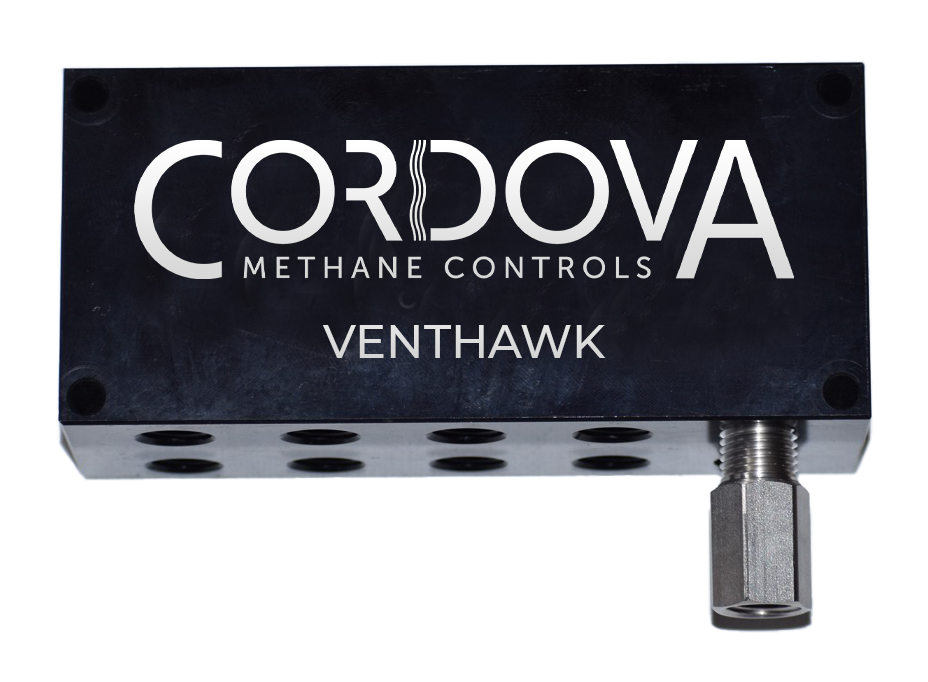
Cordova Methane Controls has partnered with Global Power Technologies to offer an enhanced methane abatement solution for legacy and smaller well sites with limited power. By combining a TEG (Thermoelectric Generator) with the VentHawk pneumatic vent gas capture system, operators can generate power and reduce methane emissions simultaneously. In this Q&A with Global Power Technologies CEO, Laura Kennedy, we learn more about the cost-effective functionality and energy-efficient design that this combination provides.
Q: What is the key benefit for producers using the VentHawk + TEG combination?
A: The beneficial use scenario for the VentHawk and TEG combination is that it destroys methane with no power being used for destruction. The power generated and saved can be used to charge batteries, power instruments, pumps, communication devices, electric heat tape and more. Single or small multi-well pads with 2-8 instruments, maybe separator, chemical pumps, communications etc.
Q: How does the VentHawk contribute to increasing efficiency for limiting emissions while the TEG generates power for on-site instrumentation?
A: TEGs are extremely efficient at destroying methane emissions, as they destroy 99.9% of methane from the fuel gas. The process to eliminate the vented gas from the pneumatic controller begins with the emitted gas being combined through the intake regulator, which runs on instrument gas. Next, the gas inlet from the pneumatic controller must not bypass the TEG’s gas safety valve. The manifold pressure is set so that the TEG is providing the proper voltage, and the parallel instrument gas supply acts as makeup gas with the intake regulator set at the minimum pressure for the TEG.
Q: How often do operators encounter situations with limited power resources on-site?
A: Across North America, it is common for older single wells or small multi-pad wells to not have any power, as they use pneumatic instruments only, solar and battery power, thermoelectric generators or other small generator options. Adding a VentHawk can capture the vented methane from the pneumatics. If there is a TEG already on site, it can be used to destroy the vented methane. If there isn’t yet a TEG on site, adding a TEG can enable battery charging in existing solar systems. The VentHawk and TEG combination adds power for new measurement, instrumentation or it can be used to replace existing generators with a more reliable and lower maintenance solution.
Q: What should operators consider when implementing a solution for limited power resources that increases emissions reduction?
A: Operators need to consider the total cost of ownership for the long term in methane reduction solutions. Low CapEx is attractive, but if it requires a truck roll with field service technicians to maintain. If it is interfering with productive operations, then total operating cost should also be considered. The VentHawk and TEG combination offers trouble-free, short annual maintenance over decades, making it the right decision both for competitive CapEx and the lowest total operating cost.
Q: How does the VentHawk and TEG combination measure emissions?
A: A TEG is proven to destroy 99.9% of methane. The TEG is a fixed flow rate, so a mass flow could be added to make a calculation vented gas captured from pneumatics. The TEG is tuned for 99.9% methane destruction.
Q: Provide an example of how the VentHawk and TEG combination can reduce emissions with an ROI?
A: When considering ROI, we recommend that operators consider the useful operating life of the well or site. The VentHawk and TEG can offer low-maintenance operations for decades. So, the total operating period can be used in the purchase considerations. ROI should consider the operating gas saved on sites with existing TEGs or generators in addition to the volume of methane reduced (tCO2e/yr or tCH4/yr) over 20 years to estimate the savings from avoiding environmental regulation fines and taxes.
There is also an opportunity for income to be generated if credits are available or if there is an internal company cost of carbon metric to measure the total benefit versus cost. The TEG is consuming vented and, in some cases, “top-up” gas that may have a defined cost in certain regions. This allows for a small amount of CO₂ from TEG emissions that may need to be accounted for in some reporting.
Q: How can the VentHawk and TEG combination help operators improve the durability, reliability and efficiency of their production sites?
A: There are two scenarios for this, determined by whether the site has an existing TEG or not.
1) For a site with existing TEG, the benefit is the decrease in instrument gas consumption to TEG by using vented gas instead. Another benefit is destroying vented gases for lower GHG.
2) For a site without an existing TEG, there is increased reliability in power that could be used to back up existing power for solar or battery powered sites or to power new instruments while also destroying gases for lower GHG.
When a TEG is combined with a VentHawk, it can offer the simplest and most cost-effective solution to decreasing vented methane to meet regulatory requirements and generate power on-site. Contact our sales team representative, Tim Westmoreland, today to learn more about how the VentHawk + TEG combination can assist your site.
Laura Kennedy is the CEO and Co-Owner of Global Power Technologies (GPT), providing the gas industry with the lowest emission and highest reliability off-grid power systems to support the industry’s “energy transition” to greener operations. With a lifelong passion for math and science, Laura holds a Bachelor of Applied Science in Mechanical Engineering from the University of Waterloo, a Master of Science in Mechanical Engineering from MIT and a Master of Science in Management from MIT Sloan. Prior to starting GPT, she worked in operational roles at Hewlett Packard, ABB and Talisman Energy.